
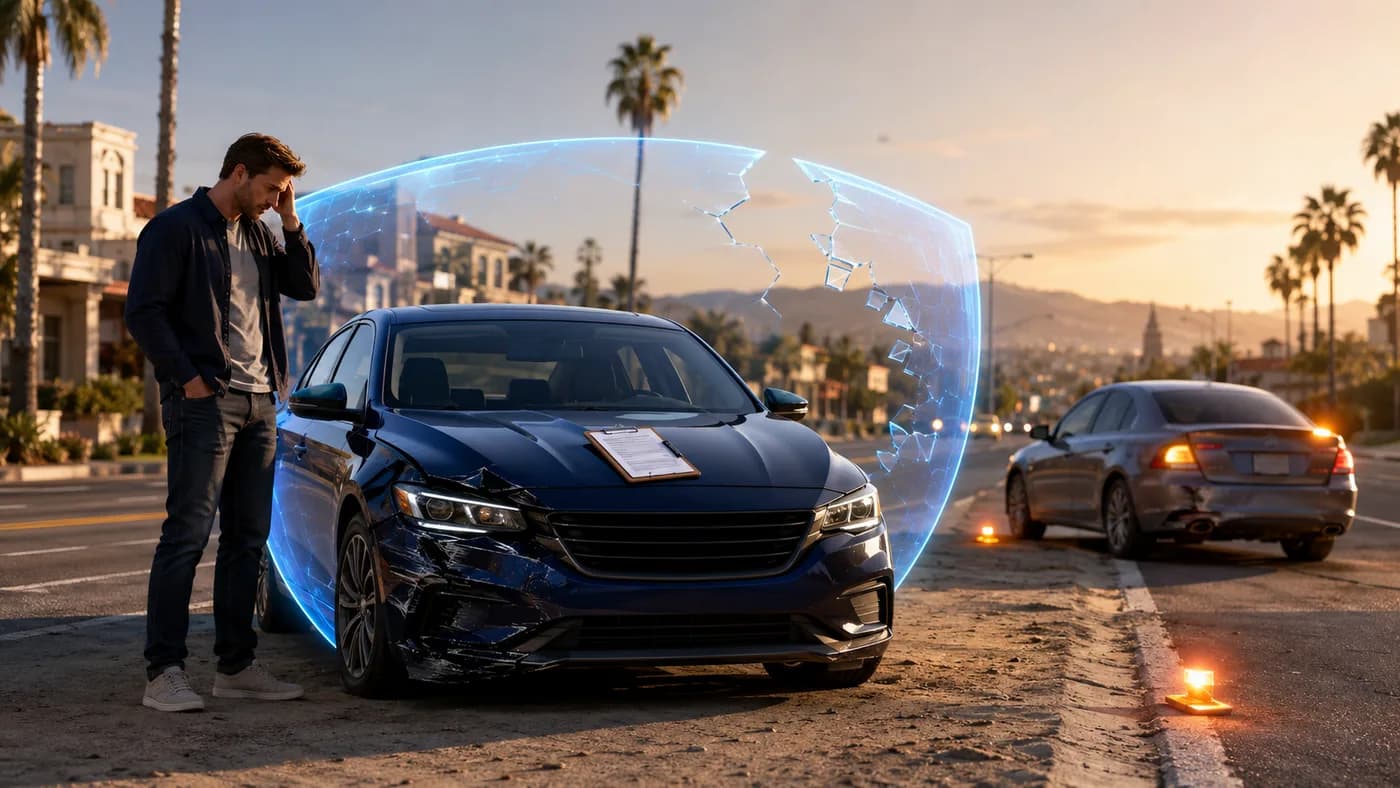
You may drive to work, pick up your kids, or run to the store hundreds of times without a problem. Then one ordinary morning, traffic slows on the 5, someone looks down for a second, and cars collide. Even at low speed, medical bills and repairs add up quickly.
That's why California requires every driver and vehicle owner to be able to show financial responsibility, most commonly through auto liability insurance. This guide explains what California's 30/60/15 minimum means, why the minimum may fall short, and what can happen if you drive without insurance.
What liability insurance actually does
Liability insurance helps pay other people when you are legally responsible for injuries or property damage caused by a covered accident.
- Bodily injury liability can apply to another person's medical expenses, lost income, or other covered damages.
- Property damage liability can apply to another vehicle, a fence, a building, or other property.
It generally does not repair your own car or pay for your own injuries. Collision, comprehensive, medical payments, and uninsured/underinsured motorist coverage address those risks. The DMV is clear that comprehensive or collision insurance by itself does not meet California's financial responsibility requirement.
California's minimum is 30/60/15
For a policy issued or renewed on or after January 1, 2025, California's minimum liability limits are:
| Limit | What it means |
|---|---|
| $30,000 | Bodily injury or death of one person in one accident |
| $60,000 | Total bodily injury or death of two or more people in one accident |
| $15,000 | Damage to other people's property in one accident |
Looking ahead: California law already schedules another increase. For policies issued or renewed on or after January 1, 2035, the minimums rise by $20,000, $40,000, and $10,000, to 50/100/25.
Key point: A limit is the most a policy may pay for a covered liability claim, subject to its terms, exclusions, and the facts. It is not a promise that every claim will be paid, or that the minimum will cover the full cost of a crash.
How the limits work in real life
- One injured person: If someone has $45,000 in covered injury damages and you're responsible, a $30,000 per-person limit won't pay more than $30,000. You could be personally responsible for the rest.
- Several injured people: If three people are hurt, each person is still capped at $30,000, and the total for everyone is capped at $60,000.
- Property damage: If you cause $25,000 in covered damage to a newer car and carry the $15,000 minimum, the policy won't pay more than $15,000 for that claim.
The California Department of Insurance puts it plainly: you will be responsible for any damage you cause beyond the limits you purchased.
One accident. Two financial realities.
Imagine Alex rear-ends another car. The other vehicle has $5,000 in damage, and its driver has $8,000 in covered injury-related damages. The combined claim is $13,000.
With an active policy and enough applicable liability coverage, the insurer can investigate, communicate with the other driver, provide a defense when required, and pay covered amounts up to the limits.
Without insurance, that $13,000 doesn't disappear. The other driver may seek payment directly from Alex through a claim, a lawsuit, a judgment, collection efforts, or a payment arrangement. A modest collision can become a personal debt.
What can happen if you drive uninsured
1. Tickets and fines. You must show evidence of financial responsibility when a peace officer lawfully asks for it; you can show it on your phone. Under Vehicle Code § 16029, a first conviction carries a base fine of $100 to $200, and a later conviction within three years carries $200 to $500, plus penalty assessments, which can make the total much higher. The court may also order the vehicle impounded.
2. Suspended registration. If the DMV does not receive proof of insurance for a vehicle, its registration will be suspended. The DMV says the vehicle may not be driven or parked on public roads until proof is submitted.
3. A suspended license after a crash. The DMV says your driving privilege will be suspended for up to four years if you're in a collision without proper insurance, no matter who was at fault. You may be able to get your license back during the last three years of the suspension by filing and maintaining an SR-22/SR-1P proof-of-insurance certificate.
4. Personal responsibility for the damage. A ticket does not pay anyone's medical bills or repairs. If you cause a crash uninsured, the injured person or property owner may seek payment directly from you.
5. Limits on what you can recover. California Civil Code § 3333.4 generally prevents an uninsured owner or driver from recovering non-economic damages, such as pain and suffering, even if the other driver caused the accident, subject to exceptions in the law. Anyone with a real injury claim should consult a licensed California attorney.
A financed car can create another problem
Your lender or lessor may require comprehensive and collision under your contract. If that coverage lapses, the lender may buy force-placed coverage and charge you for it. That coverage protects the lender's interest in the car, not you, and it is not a substitute for the liability insurance California requires.
Is the minimum enough for you?
The law sets a floor, not a recommendation. A serious injury or damage to a newer vehicle can exceed the minimum quickly. The Department of Insurance notes that the more assets you have, the more you could lose in a lawsuit. Think about the cars around you, the chance of several people being hurt, your savings and income, and what you could afford if a claim goes over your limits. Ask for quotes at several limit levels and compare the price difference with the added protection.
If cost is the barrier, don't drive uninsured. The DMV points drivers who can't afford liability insurance to the California Low Cost Automobile Insurance Program (mylowcostauto.com, 1-866-602-8861) for those who qualify.
Before you drive, check four things
- The right vehicle and regular drivers are listed or otherwise covered as your policy requires.
- The policy dates are current and your payment is up to date.
- Your limits make sense for your household, not only for the legal minimum.
- You can show proof of insurance on paper or on your phone.
Frequently asked questions
Does 30/60/15 cover my own car? No. Those numbers are liability limits for injuries and property damage you cause to others. Collision coverage generally covers damage to your own car in a crash, subject to your policy and deductible.
Can I drive if my registration is suspended for no insurance? No. The DMV says the vehicle may not be driven or parked on public roads until proof of insurance is submitted.
What if an uninsured driver hits me? Uninsured/underinsured motorist coverage may help with certain injuries when an at-fault driver has no insurance or not enough. Coverage depends on the limits you chose and your policy terms. See our uninsured motorist coverage guide.
Do I need more than the minimum? No single limit is right for everyone, but the minimum can run out quickly. Compare quotes at several limits to see the difference in price and protection.
Will the minimum limits change again? Yes. Under current law, for policies issued or renewed on or after January 1, 2035, the minimums increase to 50/100/25.
Talk with Street Smart
Not sure what your limits mean, or need coverage today? Call or text (714) 736-9048, or get a California auto insurance quote. We can help in English or Spanish.
Official sources
- California DMV: Insurance Requirements
- California Driver's Handbook, Section 10: Financial Responsibility, Insurance Requirements, and Collisions
- California Department of Insurance: Automobile Insurance Guide
- California Vehicle Code § 16056
- California Vehicle Code § 16028 and § 16029
- California Civil Code § 3333.4
Educational information: This article is general information about California personal auto insurance, not legal or financial advice or a coverage decision. Coverage depends on your policy and your insurance company. Policy terms, exclusions, eligibility, and pricing vary.
---
Be the first to ask a question.